
What is Acceptance and Commitment Therapy, Anyways?
You may have heard the term “ACT” or “Acceptance and Commitment Therapy” before - whether in a psychology in class, on a therapist website, or from a friend. It sounds fairly self-explanatory: working on accepting things and committing to things. But what are we accepting and committing to? And how do you do that? Let’s get into it and demystify ACT so you can make an informed decision about if it’s the right therapy approach for you.
ACT: The Basics
ACT is all about increasing psychological flexibility. There are many ways we can achieve that, and at it’s core we try to accept things, and commit to things. But what does that mean? Specifically, ACT is looking to help you:
Accept things that are;
Commit to things that bring you value, purpose and meaning
Acceptance does not mean that we like the thing, it just means that we are not going to spend time actively fighting against immovable things that we cannot control.
Commitment means that we do the thing that brings us value, purpose, and meaning, even when (especially when) we are dealing with hard things.
A great example that helps clarify these two processes is chronic pain. Often, folks get (understandably) caught up in being focused on their pain and how it’s affecting their quality of life - how it’s keeping them from doing things they enjoy, and how awful it feels. While this is incredibly valid, it also brings about a lot of suffering and not a lot of change. This is where acceptance and commitment comes in: If we’re going to have pain no matter what, whether we do things we enjoy or do nothing at all, then we may as well try to do things that we enjoy! We work on accepting that chronic pain is there, and commit to figuring out how to do things that are in line with our values so we can live a life full of purpose and meaning.
What are Values?
Great question. Values are things that guide our daily actions, how we live our life, and what is important to us. Think of values as our compass in life.
Sometimes, we struggle to identify values because society tries to tell us what we should, and should not value. This can lead to unhappiness and internal struggles when we are pursuing things that aren’t actually our values, or go against our values.
Other times, we have values that we feel we aren’t good at - for example, I might value organization; because I struggle with organization as a skill, I might mistakenly think that is not a value of mine and stop pursuing it. Just because you feel you’re not “good” at “living up” to a particular value, does not mean it’s not a value you hold! It just means we need to reevaluate what is going on related to that value - your understanding of the value, your thoughts and feelings, etc.
If you need some help figuring out what your values are, here are a few good resources to get you started:
Remember, values are not inherently good or bad - they just are. It is okay if you don’t value family very much, but really value friends. Also pay attention to whether you feel you should or shouldn’t value you something, versus what you actually value or do not value.
I Know My Values - Now What?
Now we look at things that help you live a life aligned with your values, and what things get in the way. There are six core processes within ACT that help us get there - some of them will sound familiar!
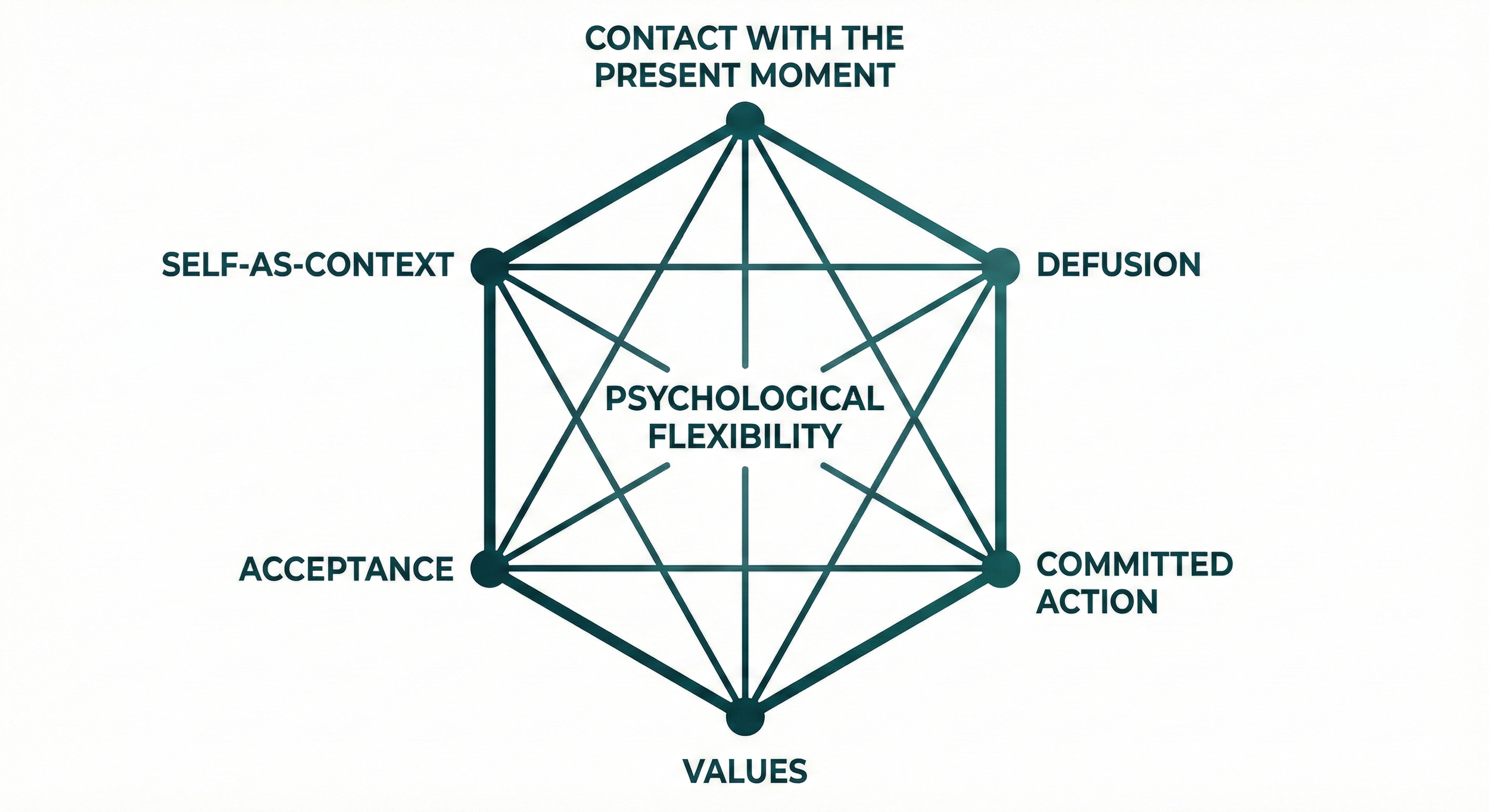
ACT Hexaflex for Psychological Flexibility
Some of those sound pretty familiar right? We’ve already talked about three of them! Let’s take a quick look at the remaining three:
Cognitive Defusion: separating ourselves, from our thoughts. I can think the sky is purple all day long but that does not make it true. We are not our thoughts. Likewise, I can think I’m stupid all day long but that does not make it true. We are not our thoughts, and when we are so fused with them that we can’t see the difference - suffering ensues.
Contact with the Present Moment: often suffering comes from us dwelling on the past or the what if’s of the future. Or, it comes from us trying to avoid the bad feelings in the present moment. By exercising mindfulness - being in the here-and-now - we can help alleviate some of that distress about things that aren’t relevant to the here and now or we can’t change no matter how much we think about them. We also learn to move through our feelings, rather than avoiding them.
Self as Context: if you thought defusion got a little meta, buckle up! We already know we are not our thoughts, thanks to defusion. This takes it a step further. Try this quick activity: observe your thoughts passing through your mind for one minute. Write down all the thoughts you observed. Now tell me this - if you are your thoughts, then who was observing? Kind of meta, I know … but it helps us realize that we can interact with our thoughts in a different way, and choose to do something, or not do something with them. Believe them, or think “Hmm. That is a thought. Thanks for that brain,” - and move on instead of getting hooked by them. If thoughts are the chess pieces, then we (our selves) are the chess board.
What is ACT Good For?
ACT is an evidence-based treatment for a variety of issues, from depression and anxiety to OCD. For more information about ACT, the evidence for it, and who/what it can help, check out The Association for Contextual Behavioral Science: https://contextualscience.org/state_act_evidence.
What’s Next?
If ACT is something that vibes with you and you’d like to try a therapist who integrates ACT into their work - reach out for a free 15-minute consult! I can answer any questions you might have, and see if we are a good fit. I’d love to help you become more psychologically flexible in pursuit of a values-driven life full of purpose and meaning.
